BATTLE // October 25, 1854
Battle of Balaclava
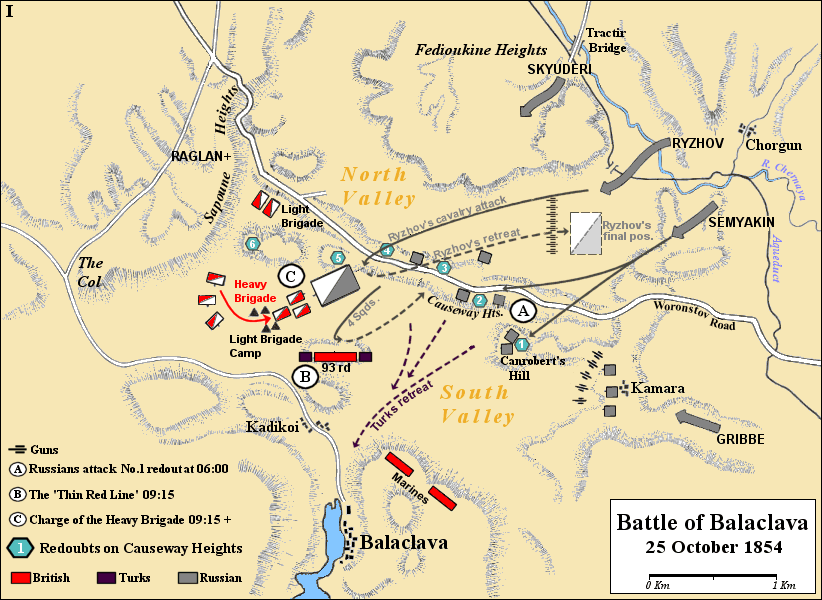
LOADING MAP TELEMETRY…
Source · Wikipedia
Significance
The Battle of Balaclava on 25 October 1854 formed part of the Allied siege operations against Sevastopol, Russia's principal naval base on the Black Sea and the central strategic objective of the Crimean War. The engagement occurred within the broader context of the Siege of Sevastopol, which the British, French, and Ottoman allies had undertaken following their victory at the Battle of the Alma in September 1854. At the Alma, Russian General Menshikov had attempted to block the Allied advance southward; the Allied success there opened the road toward Sevastopol, but a slow pursuit allowed Russian forces to regroup and consolidate their defenses. Balaclava thus took place against a backdrop of stalled momentum, with the Allies committed to siege operations rather than the rapid decisive campaign the Alma had briefly promised. The engagement involved roughly comparable forces — approximately 28,000 British and allied troops against 25,000 Russian — and produced nearly equal casualties on both sides, reflecting the inconclusive character of the fighting within the wider, grinding siege.
Forces & casualties
Troop strength
- United Kingdom28,000medium
- Russia25,000medium
United Kingdom fielded a 1.1 : 1 numerical advantage
Casualties
- Royaume-Uni de Grande-Bretagne et d'Irlande615medium
- Empire russe627medium
Commanders (5)
Russia
 Pavel Liprandi
lieutenant general
United Kingdom
 FitzRoy Somerset
field marshal
 François Canrobert
Marshal of France
Compare with sibling battle
6 options
Pick a battle to compare side-by-side
Related
6 sibling battles · 8 factions
BATTLE· September 20, 1854
Battle of Alma
BATTLE· August 1, 1854
Battle of Bomarsund
BATTLE· November 5, 1854
Battle of Inkerman
BATTLE· September 1, 1854
Siege of Petropavlovsk
FACTION· Belligerent
British Empire
FACTION· Belligerent
Caucasian Imamate
FACTION· Belligerent
Circassia
FACTION· Belligerent
Egypt Eyalet